
The journal
How do you use the penny trick to check tire tread? A practical guide
Learn how to check tire tread depth with the penny trick, what Lincoln's head shows, and when to use a quarter or gauge for safer replacement decisions.
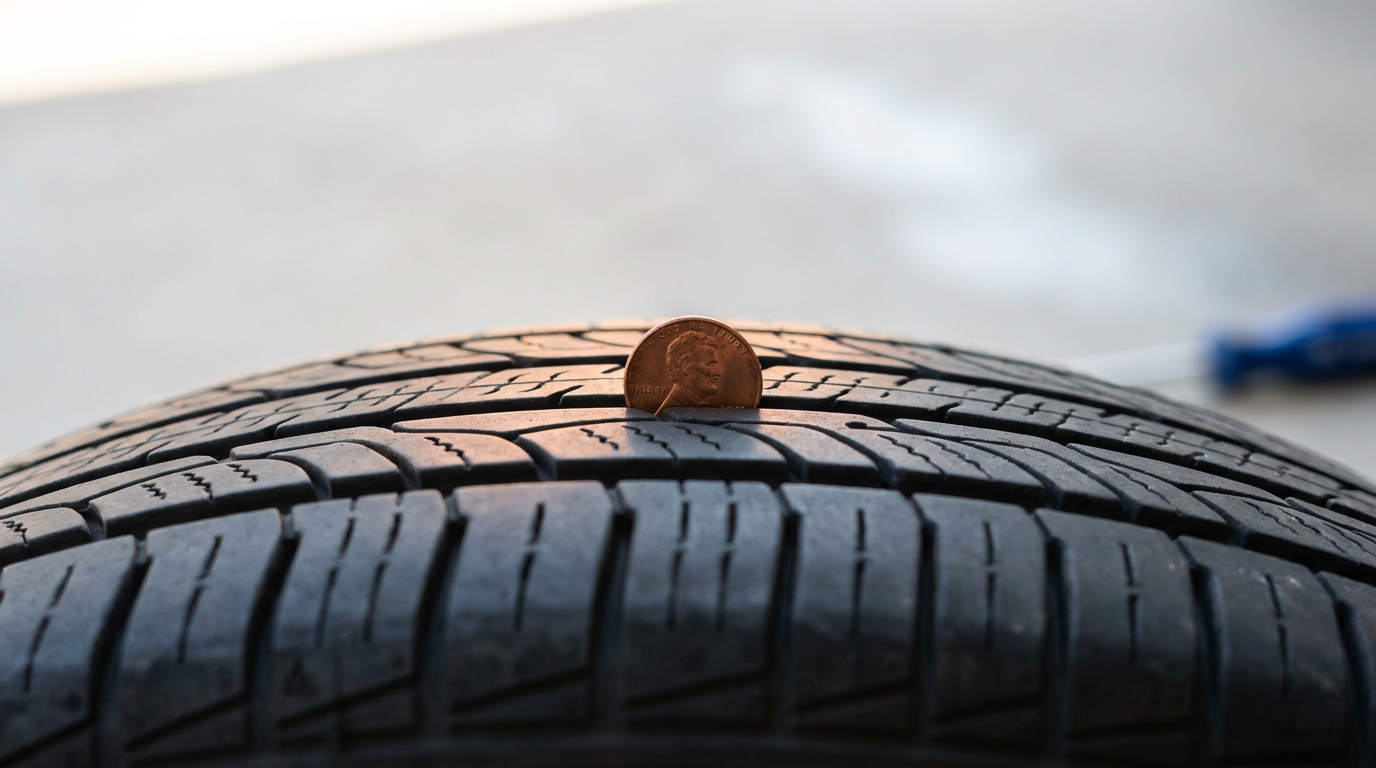
What the penny trick is and why it matters
The easiest way many drivers learn how to check tire tread depth is the penny trick: insert a penny head-first with Abraham Lincoln upside down into a main tread groove and look at how much of the head is covered. If you can see the top of Lincoln's head, the tread is below 2/32 inch and the tire should be replaced, a simple consumer method described by U.S. safety guidance NHTSA tires page and NHTSA's tire safety overview
This test matters because 2/32 inch is commonly treated as the legal minimum in many U.S. jurisdictions and is reinforced by federal tire design standards that set treadwear indicator bars at roughly that depth FMVSS No. 139 regulation
For many everyday driving conditions, however, stopping and cornering on wet roads start to suffer sooner than that minimum. Safety organizations often recommend replacing tires earlier, around 4/32 inch, to keep wet traction and braking performance stronger; the quarter test is a quick way to approximate that threshold
Use the penny trick as a fast screening check rather than a precise measurement; it gives a clear pass-or-fail cue for the 2/32-inch legal threshold and points you toward follow-up checks when readings are close to your chosen safety margin Tire Rack guidance on measuring tread depth. See our resources for related car-care tips.
How the coin test works
The penny trick relies on a known point on the coin, Abraham Lincoln's head, as a rough depth marker. Insert the penny upside down into a main tread groove so Lincoln's head faces you; if the top of his head is visible the tread is worn to or below the 2/32-inch point that most guidance treats as the minimum NHTSA tires page and Bridgestone's penny-test guide
Legal and safety thresholds for tread depth
Federal rules require passenger tires to include molded treadwear indicator bars located at approximately 1.6 mm, which is the same as 2/32 inch; when those bars are flush with the tread the tire meets the legal worn limit in many U.S. contexts FMVSS No. 139 regulation and see NHTSA's tire safety document here
Because wet traction decreases before reaching the legal minimum, many safety-minded sources suggest replacing tires at or near 4/32 inch for better wet-road performance; the quarter test gives a simple visual cue for that intermediate threshold
How to do the penny test step by step
Step 1, cool the tires if you can; testing cold tires reduces small reading changes caused by heat after driving and gives more consistent results AAA how to measure tread depth
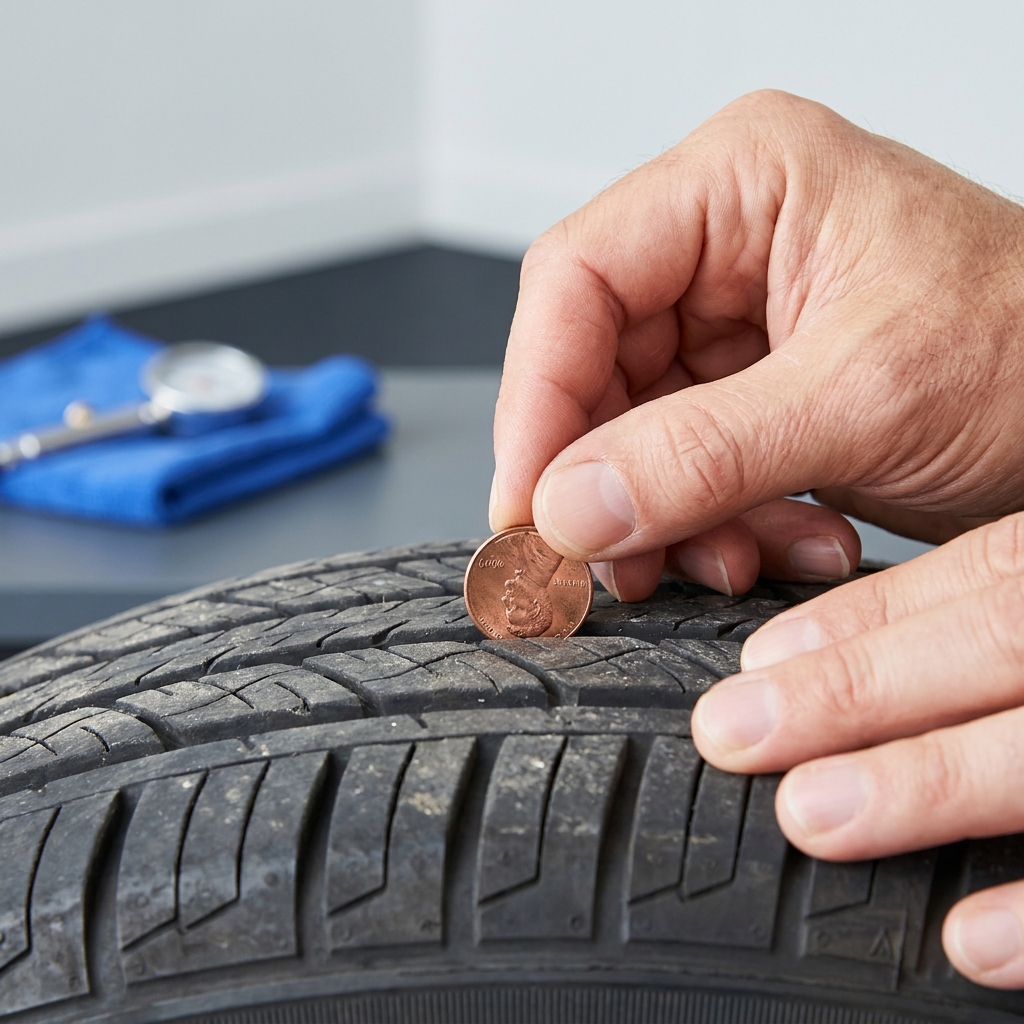
Step 2, pick a main tread groove toward the center of the tire tread rather than the extreme outer shoulder; remove stones or debris so the coin seats cleanly Tire Rack measuring tread depth
Step 3, insert the penny head-first with Lincoln upside down so that his head points toward the tread. If the top of Lincoln's head is fully visible, that spot measures below 2/32 inch and is considered worn out for most purposes NHTSA tires page
How do you use the penny trick to check tire tread?
Insert a penny head-first with Lincoln upside down into a main tread groove; if the top of Lincoln's head is visible the tread at that spot is below 2/32 inch and the tire should be scheduled for replacement. Use multiple checks, a quarter for earlier wet-weather margin, or a gauge for precise readings.
Step 4, repeat the penny insertion in several grooves across the tread and at multiple points around the tire circumference to check for uneven wear; a single spot does not represent the whole tire's condition AAA how to measure tread depth
Step 5, interpret results: if any groove shows Lincoln's head fully visible, plan replacement; if readings are close to the top of his head consider confirming with the quarter test or a dedicated gauge to decide whether earlier replacement around 4/32 inch is appropriate
Positioning the penny
Use the penny upright in a main tread groove, not lying across the treads; the coin must sit deep within a groove where the tread is thickest so Lincoln's head gives a reliable reference Tire Rack measuring tread depth
Which grooves and spots to test
Test at least three places around the tire and across the tread width: an inner groove, a central groove, and an outer groove. That pattern helps catch feathering, camber wear, or local damage that a single check would miss AAA how to measure tread depth
How to interpret what you see
If Lincoln's head is fully visible at any spot, the tread there is below 2/32 inch and the tire should be scheduled for replacement, since the coin test aligns with the common legal threshold NHTSA tires page
If the penny reading is close but not clearly showing the whole head, use a quarter test or a simple tread depth gauge for a precise reading before deciding; a little extra tread near 4/32 inch can make a measurable difference in wet braking and handling
Other quick checks: quarter test, wear bars and gauges
The quarter test is an alternative quick check for wet-road safety: insert a quarter head-first with Washington upside down into a tread groove. If you can see the top of Washington's head, the tread is near or below about 4/32 inch and wet traction will be reduced
Molded wear bars are raised ribs molded across tread grooves that become flush with the tread surface as the tire reaches the legal wear limit; locating and inspecting those bars is a fast way to confirm that the tire meets the minimum allowed depth FMVSS No. 139 regulation
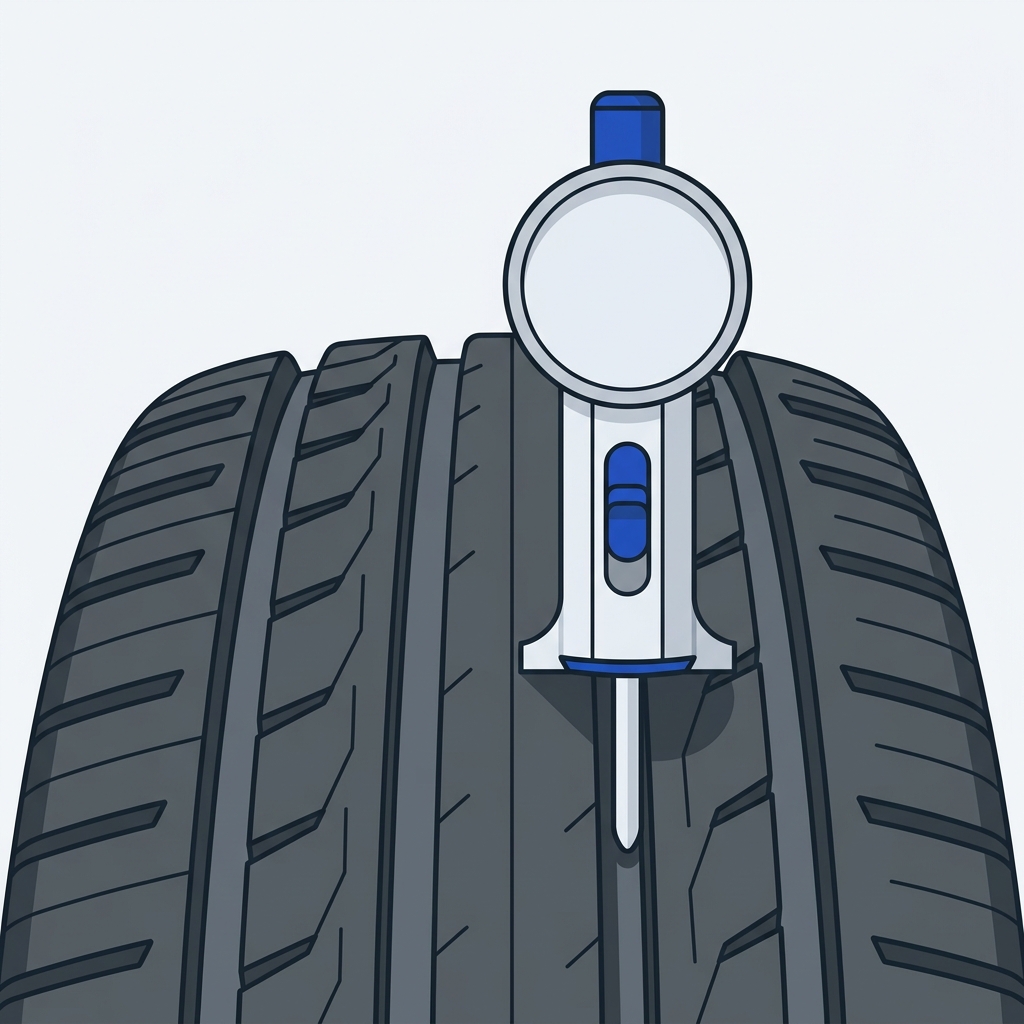
A low-cost tread depth gauge provides a more precise, repeatable reading than coin tests and is useful when results are borderline or uneven wear is present; use the gauge in the same grooves you tested with coins for a quick confirmation Tire Rack guidance on measuring tread depth
Choose the method that fits your concern: the penny test is fast for the legal 2/32 check, the quarter test helps screen for wet-weather safety near 4/32, and a gauge is best when you need an exact millimeter or 32nd-inch value before deciding to replace
Quarter test for improved wet traction
The quarter test gives a slightly deeper reference point than the penny and is a sensible follow-up if you want more wet traction margin without immediately replacing tires at the legal minimum
How to find and read molded wear bars
Look for small raised bars that cross several tread grooves; when those bars are flush with the adjacent tread surface the tire has reached the wear limit that many standards and inspections use to define end-of-life FMVSS No. 139 regulation

When a low-cost tread depth gauge is worth using
Gauges cost little and give a direct numeric reading that removes guesswork on borderline tires; they are particularly useful when uneven wear is suspected or when one spot reads close to your chosen safety threshold Tire Rack guidance on measuring tread depth
When to replace tires: decision criteria
The minimum commonly used in the U.S. is about 2/32 inch; when tread reaches that depth the tire is generally considered legally worn and replacement is recommended, as reflected by federal standards and safety guidance FMVSS No. 139 regulation
Use a simple gauge and coin checks to decide if a tire needs replacing
For improved wet traction many experts advise replacing tires earlier, around 4/32 inch rather than waiting to 2/32 inch; that approach reduces the risk of hydroplaning and shortens wet stopping distances in marginal conditions
Uneven or mixed tread depths on the same vehicle can affect handling. If only one tire or one axle shows low depth, plan replacements to preserve axle balance and vehicle stability rather than replacing a single tire in isolation whenever possible
Legal minimum versus safer thresholds
The legal limit is tied to wear indicators and the 2/32-inch convention, but if your driving includes frequent rain or heavy braking you may choose a 4/32-inch replacement target for extra margin FMVSS No. 139 regulation
Effects of uneven or mixed tread depth
Mixing tires with very different tread depths can change understeer and oversteer characteristics and may reduce traction predictability in emergency maneuvers; matching tread depth across an axle is a practical priority
How to prioritize replacement if only some tires are low
If only one tire is below your safety threshold, consider replacing at least the axle pair to retain consistent traction, and have a professional inspection if wear patterns are unusual or rapidly developing AAA how to measure tread depth
Common mistakes and how to avoid them
Measuring only one outer groove gives a false sense of security or alarm; always check multiple grooves and points around the tire to get a truer picture of wear AAA how to measure tread depth
Reading on a raised wear bar instead of in a groove is an error that can misreport depth; ensure the coin or gauge sits in the groove itself and not on a molded rib FMVSS No. 139 regulation
Checking a hot tire right after driving may produce slightly different readings; let tires cool for a short period for more consistent measurements when possible Tire Rack measuring tread depth
Ignoring sidewall cuts, bulges, or punctures is a common mistake; tread depth is only one part of tire safety, and visible sidewall damage or internal separation requires professional inspection regardless of tread depth NHTSA tires page
Measuring only one outer groove
One quick fix is to mark three positions and test them in order; that habit reduces the chance of missing inner or localized wear that a single check would not show AAA how to measure tread depth
Reading a wear bar or checking a hot tire
Always place the coin in a groove and let the tire cool if it's warm from driving; if in doubt use a gauge to confirm a borderline coin result Tire Rack guidance on measuring tread depth
Misreading coins and ignoring sidewall damage
Use a clean coin and a steady hand; if you see cuts, bulges, or embedded objects in the sidewall, stop and get a professional inspection even if tread depth appears adequate NHTSA tires page
Practical examples and a quick checklist to follow
Scenario 1, one groove shows Lincoln's head fully visible while the rest of the tire reads deeper: treat the tire as worn at the tested spot and plan replacement or an inspection, because a localized low area can expose the tire to failure AAA how to measure tread depth
Scenario 2, the pennies do not show Lincoln's head but quarters show Washington's head partially visible: you are near the 4/32-inch range and should consider earlier replacement for wet-weather safety depending on typical driving conditions
Scenario 3, readings vary widely around the tire: uneven wear suggests alignment, suspension, or inflation issues; confirm with a gauge, then rotate or replace and have a mechanic inspect the cause if wear recurs Tire Rack guidance on measuring tread depth
A compact checklist after testing
- Clean a main tread groove
- Insert penny head-first, Lincoln upside down
- Note if Lincoln's head is visible
- Test several grooves and positions around the tire
- Confirm borderline results with a quarter or a tread depth gauge
- Plan replacement or inspection if any spot meets your chosen threshold
Next steps if tread is low: schedule replacement, consider replacing tires by axle to keep balance, and address any underlying causes such as alignment or inflation to prevent repeat wear
Follow this checklist whenever you check tires before a long trip or during routine maintenance to keep decisions consistent and simple NHTSA tires page. See our care calendar for scheduling reminders.
Short real-world scenarios
A driver finds one tire with a visible Lincoln head; they replace that tire and have alignment checked because the wear was asymmetric, preventing the same pattern from affecting the new tire Tire Rack guidance on measuring tread depth
Another driver uses the quarter test during rainy season and replaces tires a bit earlier to keep wet braking distances shorter, following safety-focused advice to add margin before the 2/32 legal limit
Use the penny trick as a quick at-home screen and keep a gauge for any readings that influence immediate safety decisions Tire Rack guidance on measuring tread depth
Frequently asked questions
How accurate is the penny test?
The penny test is a quick screening method tied to the 2/32-inch guideline; it is useful for fast checks but a tread depth gauge gives a more precise reading for borderline cases.
Can I drive on tires that fail the penny test?
If Lincoln's head is fully visible, the tread is at or below the common 2/32-inch limit and you should plan to replace the tire rather than continue driving as a long-term solution.
How often should I check tread depth?
Check tires before long trips and at least once a month or during routine maintenance; inspect multiple grooves and use a gauge if results are close to your safety threshold.
Regular, simple checks help you keep tires safe between service visits. Use the penny trick as a fast screen and confirm borderline or uneven readings with a quarter or a tread depth gauge. If any spot meets your chosen threshold, plan replacement and inspect for alignment or inflation issues that could cause repeat wear.