
Write down what the ratio means before measuring. One part product to ten parts water has eleven total parts; one part product in ten total parts has ten. Use the product label’s convention and distinguish final-volume mixing from adding product to water already measured.
Choose by the job
| Decision | Why it matters | What to check |
|---|---|---|
| 1 product : 10 water | There are 11 total parts | Final volume ÷ 11 gives product |
| 1 product in 10 total | Product is one tenth of the mixture | Final volume ÷ 10 gives product |
| Fixed starting water | Adding product increases total volume | Water ÷ water-parts gives product |
| Ready to use | No dilution may be intended | Do not invent a mixing ratio |
Write the ratio in words
“One part product to ten parts water” makes eleven parts of finished mixture. “One part product in ten parts total” makes ten. If a label is ambiguous about the order or convention, ask the manufacturer. Guessing the interpretation can change the concentration.
Use a worked example
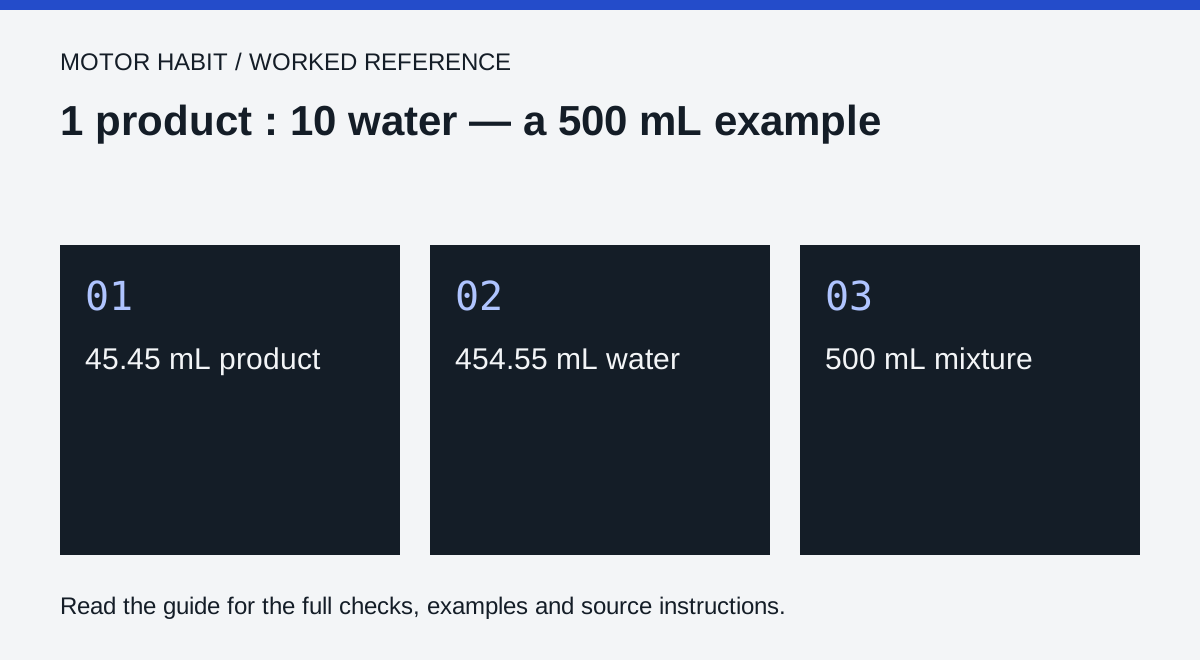
For 500 mL of finished mixture at one part product to ten parts water, divide 500 by 11. That is about 45.45 mL product and 454.55 mL water. At one part product in ten parts total, it is 50 mL product and 450 mL water. Both calculations are correct for their own stated convention.
Distinguish a bottle from existing water
If you already measured 500 mL water and need a product:water ratio of 1:10, add 50 mL product for 550 mL total. That may not fit in a nominal 500 mL bottle. Our calculator includes both starting modes to make the difference explicit.
Keep the calculation within the label
The tool calculates quantities; it does not pick a suitable cleaner or concentration. Follow the original directions for mixing order, protective equipment, permitted surfaces and storage. Label the prepared product properly. Do not use a mixing worksheet as a replacement for required chemical information.
Make the choice useful
Use a measuring method suitable for the required quantity and leave room in the container for the intended mixture. Record the exact product, ratio convention and date on a suitable label following its handling instructions. Our tool can calculate amounts from a stated ratio, but it cannot determine chemical compatibility, safe storage duration or whether the product should be diluted at all.
Before the next session
Do not mix different cleaning products unless their manufacturers explicitly direct that combination. A dilution calculation only describes quantities of a specified product and water; it does not establish the safety or effectiveness of combining chemicals.
ILLUSTRATIVE EXAMPLE
A practical example
For an illustrative 500 mL final mixture, 1 product : 10 water requires about 45.45 mL product and 454.55 mL water. One product in ten total parts instead uses 50 mL product and 450 mL water. The difference comes from the definition, not rounding.
Your next steps
- Read the convention: define each part
- Choose the mode: final volume or starting water
- Measure the amounts: follow product instructions
Questions that come up
What does 4:1 dilution mean?
It depends on which component comes first. Read the label’s words or ask the manufacturer; enter an explicit product-to-water ratio.
Does 1:10 always mean 10% product?
No. One part product to ten water is about 9.09% product. One part in ten total is 10%.
Can I mix two different cleaners if I dilute both?
Do not mix different cleaning products unless their manufacturers explicitly direct that combination. A dilution calculation only describes quantities of a specified product and water; it does not establish the safety or effectiveness of combining chemicals.
Sources and further reading
Source references for this edition, September 8, 2026. Recheck changeable rules and the exact product or vehicle instructions before acting.